When a major event hits, a winter storm, a heat wave, a power outage, it doesn't just affect one building. Dozens of buildings experience emergencies simultaneously, and every property manager is stretched thin.
A property manager juggling multiple buildings is suddenly coordinating vendors across all of them, fielding panicked calls from residents, and trying to keep boards informed. All manually. Updates slow down because there's no capacity to give them. Things slip through the cracks because there's no system tracking them. Resolution takes longer because the entire process is reactive.
It's not about effort. It's about infrastructure. One person can't orchestrate crises across multiple buildings simultaneously, no matter how hard they try.
At Daisy, we built a system designed for that reality.
Why the traditional model breaks down
When a single emergency hits, the traditional model works. A property manager gets a call, contacts a vendor, updates the resident, and moves on.
But when multiple emergencies hit simultaneously, a snowstorm, a summer power outage, flooding, that model collapses. Property managers are stretched across multiple buildings, manually coordinating each issue. They don't have the capacity to give real-time updates. They're triaging, not managing.
The process is reactive, manual, and never improves. There's no data. No system. Just one person trying to hold it all together.
How Daisy's emergency response system works
We built our emergency response around a simple principle: handling multiple emergencies simultaneously requires orchestration, not heroics.
24/7 dedicated emergency response team

Daisy's emergency response team operates around the clock from a centralized command center. When an emergency comes in, whether from a resident calling, a super reporting through the app, or a board member flagging an issue, it hits a live dashboard that the entire team can see.
Every active emergency appears in one view: the issue, the building, the status, which vendor is assigned, what residents have been told, and when resolution is expected.
Automated vendor dispatch
Each building has a preferred vendor list already in the system. When an emergency comes in, the team coordinates the appropriate vendor immediately.
Vendors receive the dispatch, confirm arrival time, and update the system when they're onsite and when the issue is resolved. Everything is tracked.
Real-time resident communication
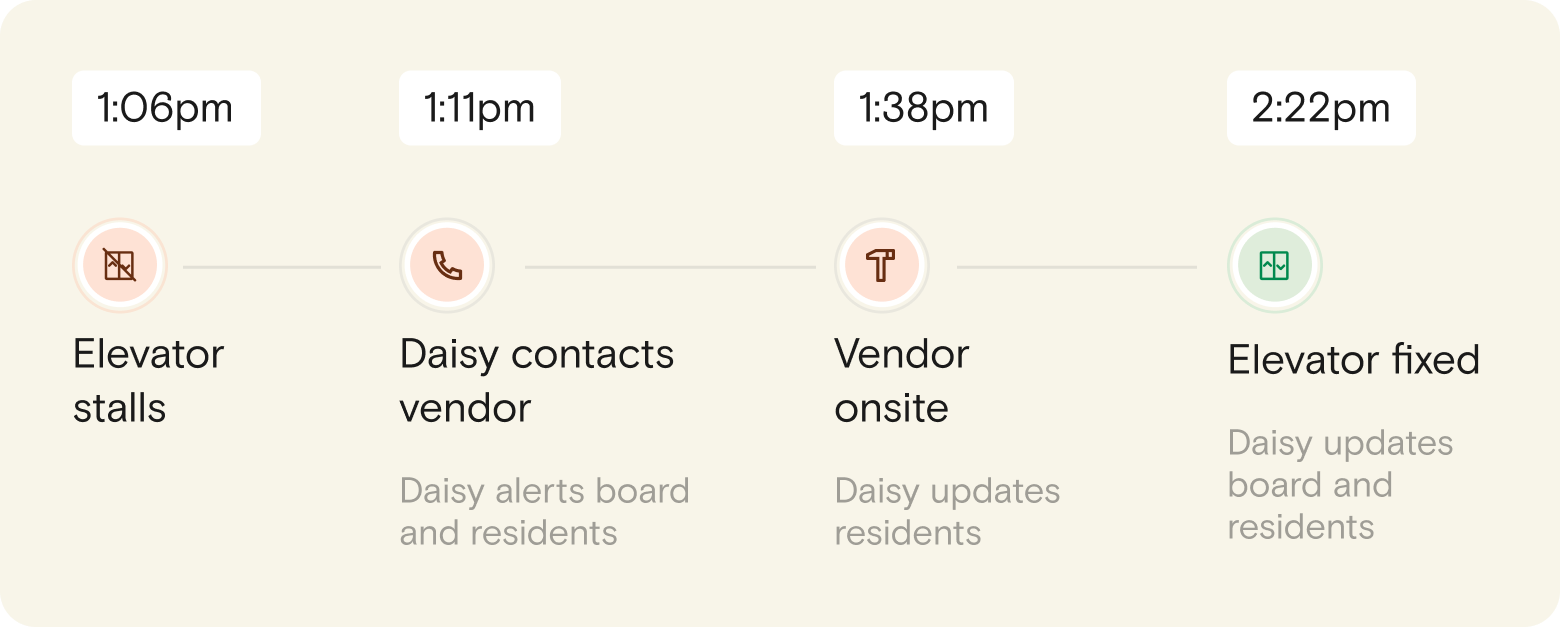
Residents receive app notifications automatically at each stage: when the emergency is logged, when a vendor is dispatched, when the vendor arrives onsite, and when the issue is resolved.
They're not left wondering what's happening. They don't need to call the super or text the board. The information comes to them.
Board visibility without the work
Boards see everything in the dashboard, what's happening, who's handling it, and when it will be fixed. They don't need to chase updates or coordinate vendors. They're informed, not involved.
What this looks like in practice
During the January 2026 winter storm that brought in two feet of snow, 31 emergencies hit Daisy-managed buildings within six hours. Here's how the system performed:
5 minutes: Average response time from emergency reported to vendor coordination
43 minutes: Average time from dispatch to vendor arrival onsite
3.1 hours: Average time from emergency reported to issue fully resolved
94%: Resident satisfaction score across all emergency responses
No emergencies fell through the cracks, no residents were left in the dark, and no boards had to coordinate vendors manually.
And this wasn't a one-time success. The system has been tested across fall flooding, summer power outages, and multiple winter storms. It works because it's designed to scale.
Why this matters
Emergency response isn't just about speed. It's about reliability.
When emergencies are handled through a centralized system instead of manual coordination:
- Response times are faster because the team isn't juggling multiple buildings manually
- Nothing falls through the cracks because everything is tracked in one system
- Boards stay informed without following up because visibility is built in
- Residents know what's happening in real-time through automated notifications
- Vendors are held accountable because performance is tracked and measured
- Issues get fully resolved faster because the entire process, from dispatch to completion, is coordinated
But the bigger difference is this: the system improves over time. Every emergency becomes data. Response patterns get analyzed. Vendor performance gets measured. The next emergency is handled better than the last.
Traditional property management can't do that. Manual processes don't generate data. One person coordinating vendors across multiple buildings can't improve a system that doesn't exist.
The takeaway
Building emergencies are inevitable. What's not inevitable is chaos.
When there's a system designed to handle multiple emergencies simultaneously, a dedicated team, real-time coordination, automated communication, and accountability built in, emergencies become manageable.
Residents get updates, vendors show up, boards stay informed, and issues get resolved. And the next time an emergency hits, the system is ready.